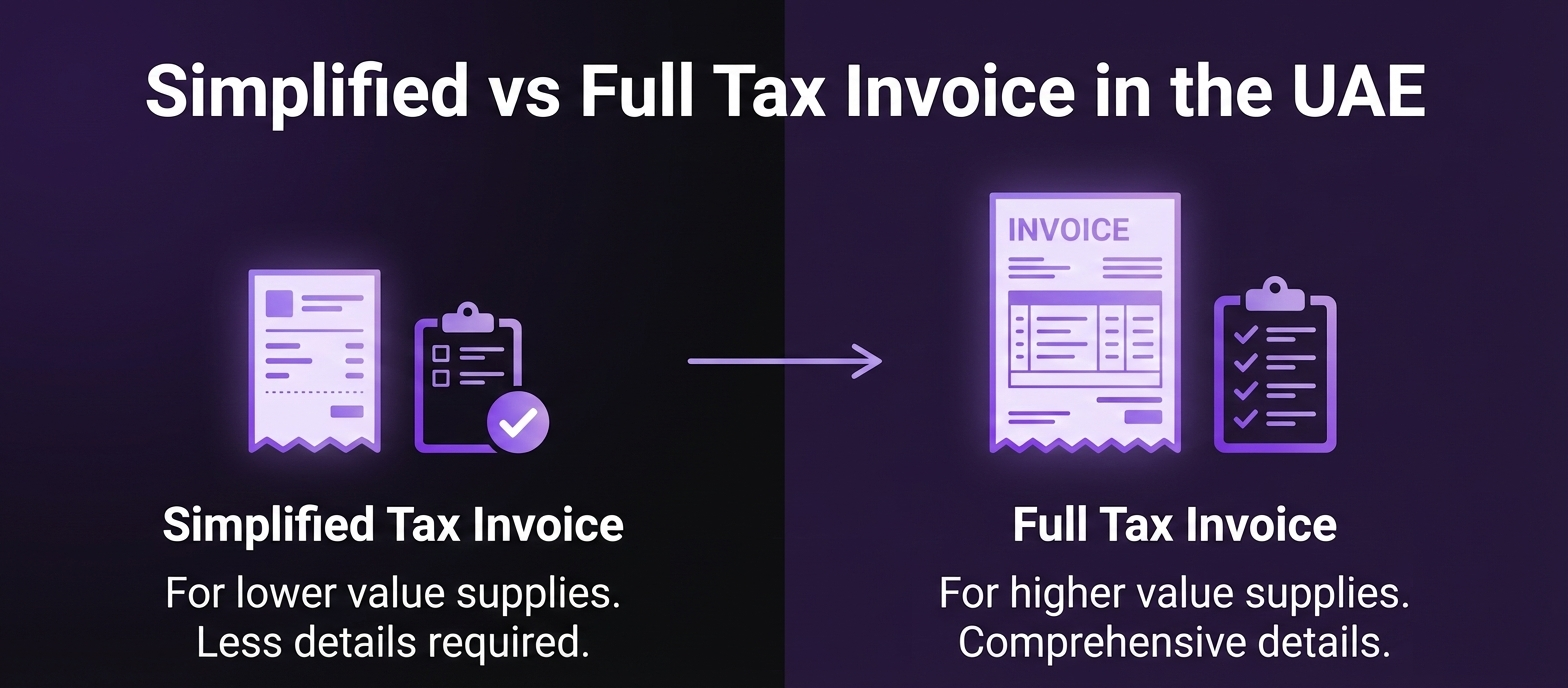
Simplified vs Full Tax Invoice in the UAE: When Can You Use Each?
In the UAE, invoices don’t all have the same VAT requirements. The rules distinguish between a full Tax Invoice and a simplified Tax Invoice.
This article is general guidance (not legal advice). Use it to quickly spot missing fields before they delay your VAT work. The references at the end point to official UAE sources.
Why the Difference Matters
When you claim input VAT or prepare VAT records, missing details can create:
- Extra back-and-forth with suppliers
- Month-end delays
- Audit questions later
So it helps to know whether the invoice you received is meant to be simplified or full, and what each should contain.
1) Full Tax Invoice (Typical for B2B)
A full tax invoice generally includes:
- The words “Tax Invoice”
- Supplier name/address and TRN
- Recipient (your business) name/address and TRN (commonly required for B2B / higher-value cases)
- A unique invoice number and issue date (and date of supply if different)
- Line items (description, quantity/unit price where relevant)
- VAT rate, VAT amount, and totals
When you’ll see it: Most B2B supplier invoices, especially where the supplier treats the transaction as needing a full tax invoice.
2) Simplified Tax Invoice (Common in Retail)
A simplified tax invoice typically contains fewer recipient details, but should still include key VAT information such as:
- The words “Tax Invoice”
- Supplier name/address and TRN
- Issue date
- Description of goods/services
- Total amount and VAT amount
When you’ll see it: Retail-style purchases and certain lower-value supplies, depending on the scenario.
Quick Checklist for VAT Record Keeping
Regardless of invoice type, if you want clean VAT records, make sure you can capture:
- Supplier TRN
- Invoice number
- Invoice date (and supply date if needed)
- Taxable amount
- VAT amount
- Total amount
- Currency (and AED equivalent where applicable)
If any of these are unclear, you’ll likely lose time later during reconciliation.
What to Do If You Received a Simplified Invoice but Need a Full One
If your accountant requires a full tax invoice (for example, to ensure your business details are included):
- Request a full tax invoice from the supplier
- Keep the simplified version as supporting evidence (audit trail)
- Record the corrected version in your VAT file
Common Red Flags (What Often Goes Wrong)
Watch for:
- No supplier TRN shown
- VAT charged but VAT amount not shown
- Totals don’t match the VAT calculation
- Invoice number missing or repeated
- Dates unclear (issue vs supply)
If you see these, it’s usually faster to request a corrected tax invoice than to “work around it” during month-end.
Sources (Official UAE References)
Frequently Asked Questions
Are simplified tax invoices valid in the UAE?
Can I claim input VAT using a simplified invoice?
What's the easiest way to check invoice compliance quickly?
Why do some invoices show VAT rate but no VAT amount?
Should I store both the original and corrected invoice?
Related Articles
UAE Tax Invoice Requirements (2026): Practical Checklist + Examples
Practical checklist for UAE tax invoices — full vs simplified requirements, common mistakes, exchange rate rules, and automation tips.
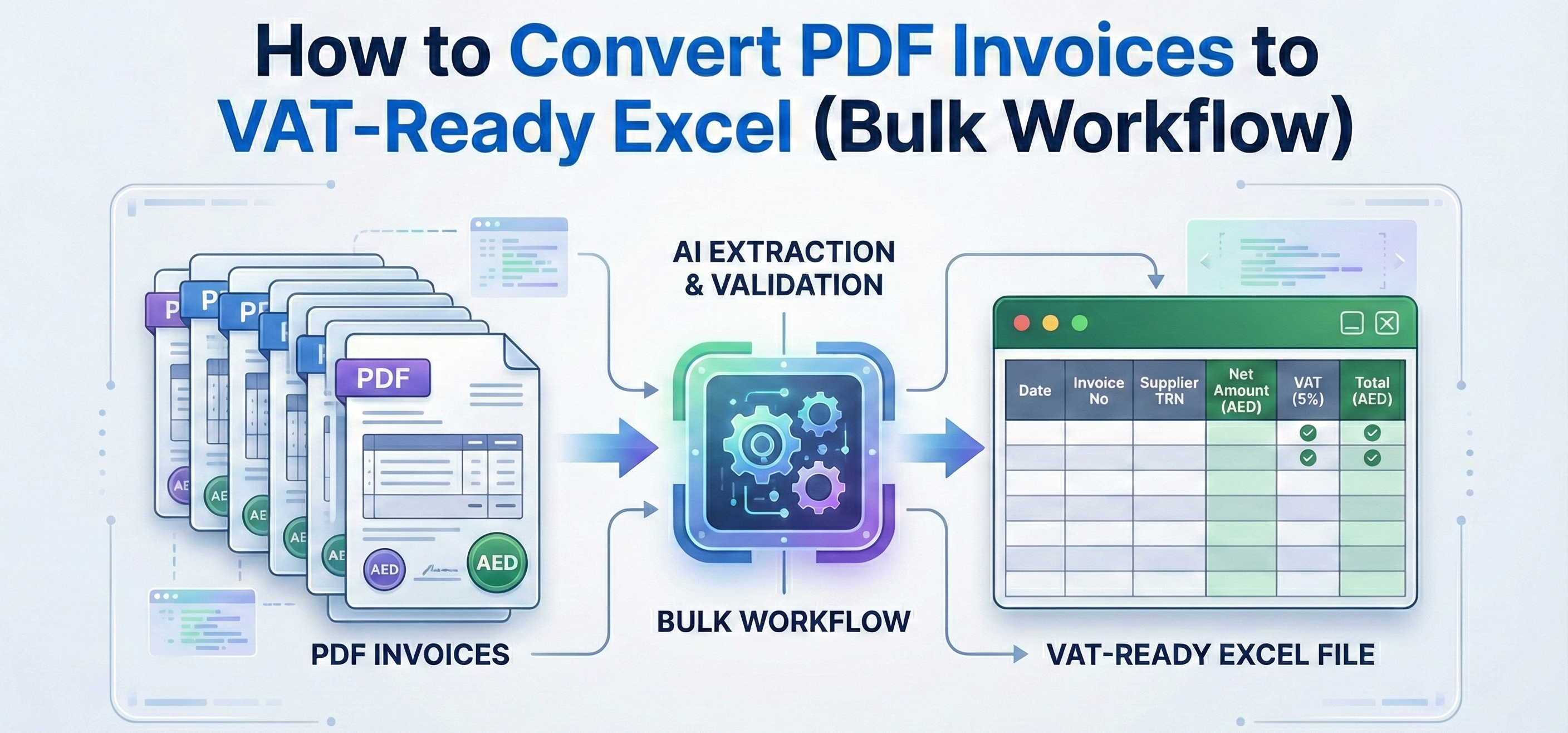
How to Convert PDF Invoices to VAT-Ready Excel (Bulk Workflow)
Step-by-step bulk workflow to convert supplier PDF invoices into a VAT-ready Excel file in the UAE — required fields, validation checks, exception handling, and best practices.